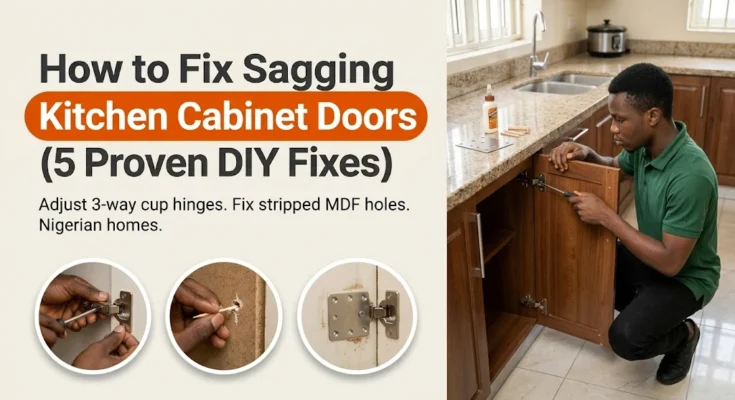
Opening the cabinet under your kitchen sink only to hear the wooden door scrape loudly across the bottom frame—or staring at a row of overhead wall cupboards that hang crookedly like broken teeth—can make even a spotless kitchen look worn out.
Across Nigerian homes, kitchen cabinets endure the harshest conditions in the house: constant steam from boiling pots, high rainy-season humidity, heavy cooking oil vapour, and the daily weight of hands pulling down on the handles. Over time, hinge screws loosen in damp wood, soft particleboard (HDF/MDF) crumbles around the mounting plates, or concealed European hinges drift out of alignment. Knowing how to fix sagging kitchen cabinet doors yourself lets you lift, straighten, and lock every crooked cupboard back into a crisp horizontal line in under thirty minutes without calling a carpenter.
Many homeowners assume that when a cabinet door starts rubbing the countertop or refusing to close flush, the wood itself has warped beyond repair and the entire kitchen unit needs replacing. In reality, 95 percent of crooked cupboard doors are caused by three simple hardware issues. Mastering how to fix sagging kitchen cabinet doors simply comes down to adjusting slipped 3-way screws on concealed cup hinges, reinforcing stripped HDF holes with wooden plugs and PVA glue, or swapping out a bent hinge arm.
Once you understand how to fix sagging kitchen cabinet doors using a manual Phillips screwdriver and basic household supplies, your kitchen cabinets will swing smoothly and line up like a brand-new showroom installation.
Step 1: Diagnose How to Fix Sagging Kitchen Cabinet Doors
Before turning any screws, open the crooked door wide and look at the metal hinges connecting the door to the cabinet box. Nigerian kitchens typically use either modern concealed European cup hinges (also called soft-close or frog hinges) or traditional surface-mounted butt hinges. Match what you see to the diagnostic table below before starting how to fix sagging kitchen cabinet doors.
| What the Door Is Doing | What You See Inside | Main Cause in Nigerian Kitchens | Best DIY Repair Method |
| Top corner tilts down & rubs neighbour | Hinge plates are solid, no loose screws | Slipped side-to-side cam screw on top hinge | Method 1: Turn the lateral tilt adjustment screw |
| Entire door scrapes bottom frame | Both hinges have slipped downward | Loose vertical mounting plate screws | Method 2: Loosen, lift door, and retighten height screws |
| Top or bottom gap pops open | Door sits too far forward from frame | Depth adjustment screw slid outward | Method 3: Adjust rear depth screw inward |
| Hinge plate rips out of sawdust board | Screws spin loosely in crumbled MDF/HDF | Steam & sink leaks softened the particleboard | Method 4: Toothpick/dowel plug or steel hinge repair plate |
| Door still binds after tightening | Hinge arm is bent or damper is broken | Rusted spring or forced door over-extension | Method 5: Swap in a new 35 mm cup hinge |
Checking these details first makes how to fix sagging kitchen cabinet doors fast and predictable:
- Crooked diagonal gap between two doors: If two double doors meet in the middle at a V-shape or rub against each other at the top corner, the top hinge’s side-to-side (lateral) screw has backed out over months of slamming. Knowing how to fix sagging kitchen cabinet doors with this symptom takes less than a minute with a star screwdriver.
- Crumbled wood around the sink cabinet: The two doors directly underneath the kitchen washbasin suffer the most from splashing dishwater and hidden pipe condensation. When dampness swells the MDF or chipboard carcass, the short 16 mm screws lose their grip and pull straight out. Before beginning how to fix sagging kitchen cabinet doors under a wet sink, seal any leaky pipes first using our guides on How to Fix a Leaking Tap and How to Fix a Leaking PVC Pipe Joint Without a Plumber.
- Traditional butt hinges on solid wood: Older carpenter-built timber kitchen frames use flat butt hinges similar to room doors. Learning how to fix sagging kitchen cabinet doors on solid timber frames simply requires plugging the stripped screw holes and tightening the leaves.
Important Safety Warnings Before Working on Kitchen Cabinets
Adjusting heavy overhead wall doors and working around under-sink plumbing requires a few practical precautions. Keep these safety rules in mind before starting how to fix sagging kitchen cabinet doors:
- Support the bottom of the door before loosening screws: A solid MDF or hardwood cabinet door weighs 4 to 8 kilograms. If you loosen both hinge mounting screws at the same time while working on how to fix sagging kitchen cabinet doors, the entire door can drop onto your fingers or crack your glass stove top.
- Empty glass plates from overhead cupboards: When working on high wall cabinets, clear fragile dishes out of the front shelf first so a sudden slip of your screwdriver does not knock glassware onto the floor.
- Stand on a stable step stool—never climb onto the countertop: Wet granite or tiled countertops and sink rims are slippery and can crack under body weight; use a sturdy A-frame ladder or low wooden stool when practicing how to fix sagging kitchen cabinet doors.
- Use a manual Phillips (star) screwdriver instead of a power drill: Power drills strip soft MDF particleboard in half a second and can snap the adjustment threads inside European hinges. Always turn cabinet hinge screws by hand.
Tools Needed for How to Fix Sagging Kitchen Cabinet Doors
You already have almost everything required for how to fix sagging kitchen cabinet doors in a basic household tool kit:
- Medium Phillips (#2 star) screwdriver: Fits 99% of European concealed hinge adjustment screws and mounting screws.
- Flathead screwdriver and a utility knife: For scraping away swollen particleboard crumbs and trimming wooden plugs flush during how to fix sagging kitchen cabinet doors.
- Wooden toothpicks, bamboo suya skewers, or 6 mm wooden dowels: Essential in how to fix sagging kitchen cabinet doors when plugging stripped screw holes in soft MDF or chipboard.
- PVA wood glue (such as Topbond): Bonds wooden plugs permanently into damaged screw holes.
- Stainless steel hinge repair plate (₦800 to ₦1,500 at hardware stores): A flat perforated metal plate that bridges over completely torn-out sink cabinet holes.
- Wooden wedges or folded cardboard shims: To prop the heavy door at the exact horizontal height while your hands are busy tightening screws.
- New 35 mm concealed cup hinge (if replacing a rusted hinge): Available in Full Overlay, Half Overlay, or Inset styles at any Nigerian furniture fittings market for ₦1,000 to ₦2,500 per pair when completing how to fix sagging kitchen cabinet doors.
Method 1: How to Fix Sagging Kitchen Cabinet Doors by Adjusting the Lateral Tilt Screw
When a cabinet door hangs crookedly—where the top outer corner dips downward and rubs against the neighbouring door while the hinges are still firmly attached to the wood—you do not need glue or new screws. Modern European cup hinges have built-in 3-way adjustment screws designed specifically for how to fix sagging kitchen cabinet doors in sixty seconds.
For a deeper mechanical look at how concealed cup hinges use eccentric cams and sliding slots to align cabinetry across three axes, see Wikipedia’s reference on Hinge.
Follow these steps to straighten a leaning door using the front lateral adjustment screw:
- Open the sagging door and locate the front screw on the hinge arm: Look at the long metal arm of the top hinge. You will see two screws along the arm: the screw closest to the door edge (front) controls left-to-right tilt, while the screw further back toward the cabinet wall controls in-and-out depth. Identifying the front screw is step one in how to fix sagging kitchen cabinet doors.
- Turn the front screw on the TOP hinge clockwise or counter-clockwise: Place your Phillips screwdriver into the front adjustment screw of the top hinge and turn it slowly while watching the hinge arm pull the top of the door inward toward the hinge side.
- Pull the top of the door back to vertical: Turning this screw moves the top corner of the door up to 4 millimetres left or right, instantly lifting the sagging outer corner up off the neighbouring door as you practice how to fix sagging kitchen cabinet doors!
- Fine-tune the bottom hinge in the opposite direction if needed: If the bottom corner is still slightly out of parallel when you close the door, adjust the front screw on the bottom hinge slightly outward until the vertical gap between your two cabinet doors is an even 2 to 3 millimetres from top to bottom—the cleanest solution in how to fix sagging kitchen cabinet doors.
Method 2: How to Fix Sagging Kitchen Cabinet Doors That Scrape the Bottom Frame
What if the entire cabinet door has slid straight down by 3 millimetres so the whole bottom edge drags noisily across the cabinet floor or kitchen countertop? That means the vertical mounting plates on the cabinet sidewall have slipped downward. Here is how to fix sagging kitchen cabinet doors using the vertical height slots:
- Prop the open door up with folded cardboard or a wooden wedge: Open the door to 90 degrees and slide a stack of folded cardboard or a wooden wedge underneath the bottom edge to hold the weight steady before starting how to fix sagging kitchen cabinet doors.
- Locate the top and bottom mounting screws on the cabinet wall plate: Look at the cross-shaped metal baseplate screwed into the vertical sidewall of the cabinet box.
- Loosen the mounting screws on both hinges by half a turn: Do not remove the screws completely! Just loosen them half a turn so the metal plate can slide up and down inside its elongated vertical slots while you work through how to fix sagging kitchen cabinet doors.
- Lift the entire door upward 2 to 4 millimetres: Raise the door until its top edge aligns dead-level with the adjacent cabinet doors, slipping an extra layer of cardboard under the bottom edge to hold the new height.
- Tighten the top and bottom mounting screws firmly: Lock the screws down by hand with your Phillips screwdriver, remove your cardboard support, and test the swing. If the hinges squeak while swinging, apply a tiny dab of grease using our guide on How to Stop Squeaky Door Hinges Permanently.
Method 3: How to Fix Sagging Kitchen Cabinet Doors That Refuse to Close Flush
Sometimes when you finish how to fix sagging kitchen cabinet doors vertically, you notice the top corner of the door still leans outward away from the cabinet box instead of sitting flat against the rubber bumper. That gap is controlled by the rear depth screw on the hinge arm.
- Locate the rear screw on the hinge arm: Look at the screw furthest inside the cabinet box along the horizontal hinge arm.
- Loosen or turn the rear depth screw: On standard slide-on hinges, loosening this rear screw by half a turn lets the entire hinge arm slide forward or backward over the baseplate; on modern cam-style hinges, turning this screw spirals the door inward or outward directly during how to fix sagging kitchen cabinet doors.
- Push the door inward until it sits flush with the cabinet face: Press the hinge side of the door inward 2 millimetres so it closes tightly against the cabinet frame, then retighten the rear screw snugly.
Method 4: How to Fix Sagging Kitchen Cabinet Doors When Screws Rip Out of MDF
Across Nigeria, most modern modular kitchens are built from laminated MDF, HDF, or high-density particleboard (chipboard). When water leaks under the sink or steam swells the board, the compressed wood turns crumbly like dry garri, and the short hinge screws rip right out of the wall—leaving the door hanging dangerously by a single hinge!
Simply driving a thicker screw into crumbled MDF will split the board and fail again tomorrow. Here are the two permanent carpenter methods for how to fix sagging kitchen cabinet doors when the wood holes are stripped out:
Option A: The Bamboo Skewer / Wooden Toothpick & PVA Glue Plug
If the screw holes are stripped loose but the surrounding wood surface is still flat and intact, follow these steps for how to fix sagging kitchen cabinet doors:
- Unscrew and remove the sagging door: Have a helper hold the door while you unscrew the mounting plates from the cabinet wall (or unclip the hinge arms) and set the door flat on the floor.
- Clean loose sawdust out of the stripped holes: Use the tip of a thin screwdriver to flick crumbly wet sawdust out of the worn screw holes and let the area dry for 1 hour.
- Pack the hole tightly with PVA glue and wooden toothpicks or suya skewers: Dip 3 or 4 wooden toothpicks (or splinters shaved from a hard bamboo suya skewer) into PVA wood glue (Topbond) and tap them tightly into the stripped hole with a small hammer until no more wood can fit—the exact structural repair technique we use in How to Fix a Wobbly Chair Leg: 5 Tested DIY Repair Methods.
- Cut the wooden plugs flush and let cure for 2 hours: Slice the protruding toothpick tips flat against the cabinet wall using a sharp utility knife, and wait 2 hours for the glue to cure into solid timber.
- Reinstall the hinge plate: Hold the hinge mounting plate over the plugged holes and drive your original screws straight into the glued wooden plugs using a manual screwdriver. The new solid wood core grips the screw threads tighter than the original particleboard, completing a rock-solid repair for how to fix sagging kitchen cabinet doors.
Option B: Install a Stainless Steel Hinge Repair Plate (For Torn-Out Holes)
What if the particleboard under your kitchen sink is so badly rotted or torn out that a 3-centimetre crater has ripped out around the hinge cup or sidewall? Wood glue and toothpicks cannot fill a gaping crater. A stainless steel hinge repair plate is the ultimate 10-minute rescue when figuring out how to fix sagging kitchen cabinet doors with torn MDF:
- Buy a universal stainless steel hinge repair plate: Available at Nigerian furniture hardware markets and online stores for ₦800 to ₦1,500, this flat steel bracket has pre-drilled holes that spread the hinge load across wide, undamaged wood 4 centimetres away from the rotted hole.
- Place the steel plate over the torn crater: Align the large 35 mm hole (or mounting slots) of the steel repair plate directly over the damaged zone on the door or cabinet sidewall as part of how to fix sagging kitchen cabinet doors.
- Screw the steel plate into fresh, solid wood around the perimeter: Drive the four or six short wood screws provided with the plate into the clean, undamaged board along the top and bottom edges of the plate.
- Screw your hinge directly onto the steel plate: Reattach your cabinet hinge onto the pre-punched holes of the steel plate and clip the door back on—instantly solving how to fix sagging kitchen cabinet doors without replacing the cabinet panel!
Method 5: Replace Bent or Rusted Hinges and Check Adjacent Drawers
In damp coastal cities like Lagos, Port Harcourt, and Warri—or inside poorly ventilated kitchens—steam and salt air eventually rust the internal coil springs of cheap concealed hinges until the metal arm cracks. If tightening and adjusting the screws does not hold the door up, swapping the hinge is the final step in how to fix sagging kitchen cabinet doors:
- Take one old hinge to the hardware market to match the overlay bend: European 35 mm cup hinges look identical at a glance, but the neck of the arm comes in three different bends that you must match when shopping for how to fix sagging kitchen cabinet doors:
- Straight arm (Full Overlay): For doors that cover the entire front edge of the cabinet sidewall.
- Half-cranked arm (Half Overlay): For two doors sharing a single middle partition wall.
- High-cranked arm (Inset): For doors that sit recessed inside the cabinet frame opening.
- Buy stainless steel (SUS 304) soft-close hinges: Spending an extra ₦500 on rust-proof stainless steel hinges prevents bathroom and kitchen humidity from seizing the mechanism again.
- Pop the new 35 mm cup into the door hole and screw it square: Keep the bottom edge of the hinge cup strictly parallel to the edge of the door before driving the two cup screws home.
- Check your kitchen drawers and handles at the same time: While you have your screwdriver out in the kitchen for how to fix sagging kitchen cabinet doors, tighten any loose pull handles using our guide on How to Fix a Loose Door Handle and lubricate sticking cutlery drawers with How to Fix a Drawer That Won’t Slide.
Common Mistakes to Avoid When Fixing Sagging Cabinet Doors
Steer clear of these four common blunders when working through how to fix sagging kitchen cabinet doors:
- Unscrewing the front adjustment screw completely out of the hinge arm: On older slide-on hinges, the front tilt screw does not have a safety stop—if you unscrew it too far counter-clockwise, it falls out of the threads and the door drops! Only turn adjustment screws 1 to 2 turns at a time when practicing how to fix sagging kitchen cabinet doors.
- Stuffing wet paper, matchboxes, or nylon into stripped MDF holes: Soft paper or plastic compresses under the weight of a swinging door within three days; always use hard wooden toothpicks/skewers bonded with PVA wood glue or a metal repair plate.
- Driving longer 2-inch screws through a thin 16 mm cabinet sidewall: Standard kitchen cabinet boards are only 15 mm to 18 mm thick. Using a long screw to get more grip during how to fix sagging kitchen cabinet doors will punch the sharp tip right out the visible side of your cabinet panel!
- Hanging heavy wet dish towels over the top edge of the door: Draping wet towels over an MDF cabinet door swells the top edge and adds constant downward leverage that pulls the top hinge out of alignment.
Frequently Asked Questions (FAQs)
Which screw on a concealed hinge lifts a sagging kitchen cabinet door?
When learning how to fix sagging kitchen cabinet doors, if only the outer corner of the door is dipping down diagonally, turn the front adjustment screw (closest to the door edge) on the top hinge to pull the top of the door inward toward the cabinet sidewall, which lifts the outer corner straight up. If the entire door has dropped vertically, loosen the top and bottom mounting screws on the cross-plate attached to the cabinet wall, lift the whole door up 3 mm, and retighten.
How do I fix a kitchen cabinet hinge that ripped completely out of particleboard?
The strongest way to handle how to fix sagging kitchen cabinet doors when the hinge rips a chunk out of soft particleboard (MDF/chipboard) is to screw a stainless steel hinge repair bracket (₦1,000) over the damaged area so the hinge anchors into solid wood around the crater. If only the small screw holes are stripped without tearing the board face, pack the holes tightly with wooden toothpicks dipped in PVA wood glue, let dry for 2 hours, cut flush, and drive the screws back in.
Why do my kitchen cabinet doors keep going out of alignment every few months?
Repeated sagging happens for three reasons: first, loose mounting screws slipping inside damp particleboard; second, slamming doors without soft-close dampers (which vibrates the lateral adjustment screw loose); and third, weak two-hinge setups on tall, heavy pantry doors. Adding a third middle hinge to tall doors over 90 cm high shares the weight and permanently solves how to fix sagging kitchen cabinet doors.
Final Thoughts
Taking twenty minutes to turn the front lateral adjustment screw on your top hinge, plug stripped under-sink screw holes with glued wooden skewers, or bolt on a stainless steel repair plate proves just how easy it is to master how to fix sagging kitchen cabinet doors. Instead of fighting crooked cupboard doors that scrape your countertops and refuse to shut, your entire kitchen will look crisp, level, and newly installed.