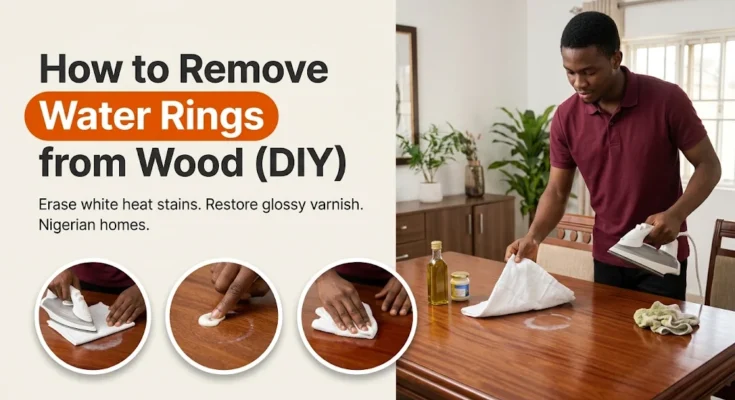
Setting a chilled bottle of malt, a sweating glass of cold water, or a steaming bowl of jollof rice directly onto a polished mahogany dining table without a coaster is a mistake every homeowner regrets the moment the dish is lifted. Right where the glass sat, an ugly cloudy white halo—or a dark, sunken ring—stares back at you through the varnish. Knowing how to remove water rings from wood safely lets you pull trapped moisture right out of the clear finish using everyday household items instead of paying a carpenter tens of thousands of Naira to sand and re-spray the entire tabletop.
Across Nigerian homes, wooden dining sets, centre tables, and bedside cabinets face constant humidity swings and hot serving bowls. Many people panic when they see a milky white blotch on their favourite furniture and immediately scrape at it with a rough sponge or splash harsh chemicals over the surface, turning a shallow blemish into a permanent raw patch. The secret to mastering how to remove water rings from wood lies in looking closely at the colour of the stain before you touch it.
Once you understand how to remove water rings from wood by matching the shade of the ring to the right gentle heat, oil, or mild polishing method, you can restore a glassy showroom shine to any wooden table in under twenty minutes.
Step 1: Check Ring Colour Before Learning How to Remove Water Rings from Wood
Not every cup mark or hot-pot blemish sits at the same depth inside your furniture. Before choosing a treatment for how to remove water rings from wood, inspect the shade of the mark under bright daylight.
| Ring Colour | Stain Depth | Main Household Cause | Best DIY Method |
| Cloudy white or milky grey | Trapped in top varnish layer | Sweating cold drinks or hot plates | Method 1 (Iron) or Method 2 (Hairdryer) |
| Hazy pale ring with rough feel | Mid-level lacquer bloom | Warm teacup or damp cloth left overnight | Method 3 (Mayonnaise) or Method 4 (Toothpaste) |
| Dark brown or black circle | Deep inside raw wood grain | Standing water or leaking flower pot | Method 5 (Vinegar & Oil) or Method 6 (Peroxide) |
| Sticky dull ring on wax polish | Surface wax emulsification | Spilled soup, tea, or condensation | Method 7 (Salt & Mineral Oil Paste) |
Understanding the difference between white and black marks is the foundation of how to remove water rings from wood:
- White or cloudy rings (Trapped in the finish): When a hot dish or wet glass sits on a lacquered, varnished, or shellacked table, heat and condensation open the microscopic pores of the clear topcoat just long enough for moisture to slip inside. As the finish cools, the pores close and trap water vapour inside the clear varnish—not in the wood itself. Learning how to remove water rings from wood when the mark is white simply means reopening those pores with gentle warmth or displacing the moisture with oil.
- Dark brown or black rings (Deep in the wood): If water sat on the table for days—such as under a leaking flower vase or near a rainy window—the liquid has soaked through cracked varnish into the raw timber fibres below, reacting with natural wood tannins. Knowing how to remove water rings from wood when the circle has turned black requires brightening the timber before resealing the surface.
- Peeling or flaking table finishes: If the clear varnish across your entire dining table is already cracking and peeling off in sheets, spot treatment won’t be enough—follow our complete restoration tutorial on How to Refinish an Old Wooden Table: Step-by-Step DIY Guide alongside these tips on how to remove water rings from wood.
Important Safety Warnings Before You Treat Wooden Furniture
Applying heat, household pastes, or mild bleaching agents to polished Nigerian hardwood requires careful control. Keep these safety rules in mind before starting how to remove water rings from wood:
- Never touch a hot iron directly to bare wood: Direct metal heat will scorch and melt nitrocellulose lacquer or polyurethane varnish in two seconds; always keep a clean, 100% cotton cloth barrier between the iron and the table when practicing how to remove water rings from wood.
- Turn off the steam function on your electric iron: Attempting how to remove water rings from wood with a steam iron that is still spitting water droplets will pump more moisture into the varnish and expand the white cloud. Empty all water from the tank first.
- Use plain white cotton cloths only: Heat and oils can transfer dye from patterned Ankara or coloured towels straight into softened table varnish.
- Test every paste in a hidden corner first: Before rubbing toothpaste or baking soda onto the middle of your parlour centre table, test a tiny dab on the underside rim to confirm it does not dull the gloss sheen.
Tools Needed for How to Remove Water Rings from Wood
You do not need expensive imported strippers to master how to remove water rings from wood. Gather the supplies for your chosen method from your kitchen or bedroom:
- Three clean white cotton cloths: An old white cotton singlet, pillowcase, or handkerchief works best for heat transfer and buffing.
- Electric pressing iron (water emptied) OR a hairdryer: Essential in how to remove water rings from wood when evaporating fresh milky moisture clouds out of clear varnish.
- Plain white non-gel toothpaste: Must be classic white paste—never blue or green mint gel.
- Mayonnaise or plain petroleum jelly (Vaseline): Rich oils displace moisture trapped inside cloudy lacquer pores.
- Baking soda and fine table salt: For mixing a gentle micro-polishing paste.
- Olive oil, baby oil, or lemon oil: Restores lustre and seals dry pores after completing how to remove water rings from wood.
- Distilled white vinegar and 3% hydrogen peroxide: Available at any supermarket or pharmacy for lifting deep dark stains out of raw timber.
- Clear paste wax or beeswax polish: Protects the newly restored tabletop against future spills.
Method 1: How to Remove Water Rings from Wood Using a Dry Iron
If a guest just lifted a hot bowl of pepper soup or a cold glass of water and left a fresh white shadow on your dining table, the dry clothes-iron trick is the fastest way to tackle how to remove water rings from wood. Gentle dry warmth opens the topcoat pores just enough for trapped moisture vapour to escape upward into the cotton cloth.
- Wipe the tabletop completely dry: Use a soft cloth to clear standing water droplets or food crumbs around the stain before starting how to remove water rings from wood.
- Empty your pressing iron and set it to Low: Pour every drop of water out of the iron reservoir, switch the Steam setting OFF, and turn the dial to its lowest fabric setting (Silk or Nylon).
- Lay a folded white cotton cloth over the ring: Spread a clean, dry white cotton t-shirt or pillowcase folded two layers thick directly over the cloudy stain—never use polyester fabric, which can melt onto the varnish.
- Glide the warm iron in circles for 5 to 10 seconds: Place the warm iron onto the cotton cloth and move it continuously in slow circles over the mark for 5 to 10 seconds. Never leave the iron parked in one spot.
- Lift the cloth immediately to release steam: Peel the cotton cloth back right away so the rising moisture does not condense back into the table. Usually, the milky ring fades by half on the very first pass.
- Repeat in 10-second intervals and buff with oil: Fold the cloth to a fresh dry section and warm the spot for another 10 seconds until the white haze vanishes, completing the cleanest technique for how to remove water rings from wood.
Method 2: How to Remove Water Rings from Wood with a Hairdryer
If you feel nervous about placing a hot metal iron over an expensive mahogany or teak tabletop, a standard bedroom hairdryer offers a completely touch-free approach to how to remove water rings from wood.
- Set your hairdryer to Warm heat: Plug in the dryer, turn the fan speed to high, and select the Warm or Low heat setting rather than scorching maximum heat.
- Hold the nozzle 10 to 15 cm above the stain: Point the airflow at a slight angle across the white ring and sweep the dryer back and forth continuously while executing how to remove water rings from wood so no single spot overheats.
- Watch the cloudy ring evaporate over 5 to 10 minutes: As warm air circulates across the varnish, trapped water molecules expand and vent out of the finish.
- Condition the warmed finish with oil: Once the white ring disappears, rub two drops of baby oil or olive oil onto the spot with a soft cloth to rehydrate the resin. While inspecting your dining set, check if any chairs have worked loose over time using our guide on How to Fix a Wobbly Chair Leg: 5 Tested DIY Repair Methods.
Method 3: How to Remove Water Rings from Wood with Mayonnaise or Vaseline
What if a white water ring has been sitting on your wooden coffee table or sideboard for weeks and gentle heat alone won’t budge it? Oil displacement is the most reliable overnight solution for how to remove water rings from wood. Both kitchen mayonnaise and plain petroleum jelly (Vaseline) are rich in oils that seep slowly into microscopic pores in shellac and lacquer, pushing trapped water droplets out.
- Dab a generous layer onto the white ring: Spoon enough mayonnaise or plain unscented Vaseline onto the mark to cover the entire white outline in a 2-millimetre layer as the first step in how to remove water rings from wood.
- Massage gently with your fingertips: Rub the cream into the stain in small circular motions for 60 seconds using your finger or a soft white cloth so the oil begins penetrating the surface pores.
- Cover and leave for 4 to 12 hours: Let the mayonnaise or Vaseline sit undisturbed for at least 4 hours—or overnight for stubborn older marks. (If using mayonnaise in a warm Nigerian room, invert a clean bowl over the spot so ants or flies cannot reach it!)
- Wipe clean and buff along the grain: Wipe away the dried cream with a slightly damp cloth, dry immediately, and buff briskly with a clean microfibre towel.
Method 4: How to Remove Water Rings from Wood with White Toothpaste
When a hot pot or sweating mug has etched a rough, stubborn white ring into hard polyurethane or glossy varnish, a gentle micro-abrasive polish is the secret to how to remove water rings from wood. For a deeper technical breakdown of how shellac, lacquer, and polyurethane resin coats react to heat and moisture, see Wikipedia’s reference on Wood finishing.
Follow this careful polishing routine when practicing how to remove water rings from wood with toothpaste:
- Use plain WHITE non-gel toothpaste: Squeeze a pea-sized dab onto your cloth—it must be opaque white paste (such as plain white Colgate or Pepsodent), which contains ultra-fine calcium carbonate chalk. Never use gritty charcoal paste or coloured mint gel.
- Add a pinch of baking soda for deep heat marks: For stubborn white heat blotches from hot serving dishes, mix equal parts white toothpaste and baking soda with two drops of water when preparing for how to remove water rings from wood.
- Rub strictly IN THE DIRECTION of the wood grain: Wrap a barely damp white cotton cloth around your index finger, pick up the paste, and stroke gently back and forth parallel to the wood grain for 30 to 45 seconds. Never scrub in circles across the grain.
- Wipe clean and seal with oil or wax: Wipe the paste away completely with a clean damp cloth, dry the spot, and buff in a drop of olive oil or furniture wax to blend the gloss sheen.
Method 5: How to Remove Water Rings from Wood Using Vinegar and Olive Oil
When hard borehole water splashes onto wooden window sills or dining surfaces and leaves both a cloudy ring and crusty mineral spots, combining mild household vinegar with olive oil solves both issues at once. Here is how to remove water rings from wood using this two-ingredient pantry conditioner:
- Whisk equal parts white vinegar and olive oil: In a small cup, mix 2 tablespoons of distilled white vinegar with 2 tablespoons of olive oil (or mineral oil).
- Rub along the grain from the centre outward: Dip a clean white microfibre cloth into the emulsion and work it across the mark following the timber grain. The mild acetic acid dissolves chalky borehole mineral rings while the olive oil penetrates and darkens the pale, dried-out finish pores.
- Buff dry with a fresh towel: After 2 minutes of gentle rubbing, polish the tabletop dry to an even, streak-free lustre.
Method 6: How to Remove Dark or Black Water Stains from Wood
If you lift a potted plant or water jug and discover a dark brown or black ring, heat and mayonnaise will not erase it because water has oxidized the tannins inside the raw timber fibres. Learning how to remove water rings from wood when the stain has turned dark requires lifting the oxidation out of the grain carefully:
- Confirm the timber is dry first: Let the table dry for 24 hours (and if the furniture sits in a damp room, review our moisture-control tips in How to Care for Wooden Floors in a Humid Climate: Practical DIY Guide).
- Lightly scuff flaky varnish over the black line: If cracked varnish sits over the black ring, lightly stroke just the stained line along the grain using ultra-fine 220-grit sandpaper so your brightening solution can reach the stained fibres.
- Dab 3% hydrogen peroxide onto the dark ring: Dip a cotton bud into 3% pharmacy hydrogen peroxide and trace it carefully along the black ring only—avoid wetting the surrounding unstained wood.
- Wait 15 to 30 minutes, neutralize, and reseal: Once the peroxide lightens the black tannin mark back to natural wood tone, wipe clean with a damp cloth, let dry for 4 hours, and brush on a thin touch-up coat of clear polyurethane varnish or wax.
Method 7: How to Remove Water Rings from Wood with Salt and Mineral Oil
For waxed antique furniture, carved Nigerian iroko stools, and oil-finished wooden trays, this gentle salt-paste method is a classic carpenter’s secret for how to remove water rings from wood without stripping hand-rubbed finishes:
- Mix a paste of salt and oil: Combine 1 teaspoon of fine table salt with a few drops of mineral oil, baby oil, or olive oil until it forms a smooth paste.
- Glide lightly along the grain and rest 15 minutes: Stroke the paste gently over the white ring—the salt crystals draw out dampness while the oil re-emulsifies the wax finish.
- Wipe and buff to a warm gloss: Wipe away every grain of salt with an oil-dampened cloth and buff dry. (While sprucing up your bedroom or study furniture, you can also silence noisy timber joints nearby using our guides on How to Stop a Wooden Bed Frame from Squeaking and How to Fix a Drawer That Won’t Slide.)
Common Mistakes to Avoid When Removing Water Rings
Steer clear of these four destructive pitfalls when working through how to remove water rings from wood:
- Using nail polish remover (acetone) or paint thinner: Rubbing acetone on a white ring dissolves lacquer and varnish instantly, leaving a sticky crater that requires stripping the entire table.
- Scrubbing with green scouring pads or steel wool: Rough kitchen scrubbers carve deep grey scratches across glossy wood finishes in seconds; only use soft cotton or microfibre cloths when practicing how to remove water rings from wood.
- Leaving raw groundnut oil or palm oil on bare wood: Cooking oils turn sticky and rancid in humid Nigerian weather; if you use olive oil or mayonnaise to lift a stain, always wipe the surface clean afterward and seal with proper furniture paste wax.
- Parking a hot iron stationary on the cloth: Leaving a hot iron sitting in one spot for a full minute can bake the fabric weave pattern directly into softened lacquer! Keep the iron moving and lift the cloth every 5 to 10 seconds.
Frequently Asked Questions (FAQs)
Why do hot plates leave a white ring on wooden tables just like cold water does?
When learning how to remove water rings from wood, many homeowners wonder why a dry hot plate leaves the exact same milky cloud as a wet glass. Heat softens the clear lacquer or varnish and allows moisture vapour from the humid air or steaming food to slip into the opened finish pores, trapping it inside as the surface cools.
Does Vaseline or mayonnaise really remove water stains from wood?
Yes! Both plain petroleum jelly (Vaseline) and mayonnaise are proven household solutions for how to remove water rings from wood when the stain is white or cloudy. Their slow-penetrating oils seep into microscopic varnish pores over 4 to 12 hours, displacing trapped water droplets and restoring clarity.
How do I know if a water stain is in the finish or in the wood itself?
Wipe a single drop of baby oil or clean water over the ring and watch for three seconds. If the white cloudy ring temporarily disappears while wet, the stain sits purely inside the clear topcoat and will come out easily using the iron, mayonnaise, or toothpaste steps in this guide on how to remove water rings from wood. If the ring stays dark brown or black, the moisture has reached the raw timber underneath.
Final Thoughts
Taking fifteen minutes to warm away a fresh milky cloud with a dry cotton cloth and iron—or massaging a dab of mayonnaise, petroleum jelly, or white toothpaste along the wood grain—proves just how simple it is to master how to remove water rings from wood. Instead of hiding your dining table under a plastic cover or paying for a costly respray, your wooden furniture will stay rich, glossy, and blemish-free for years.