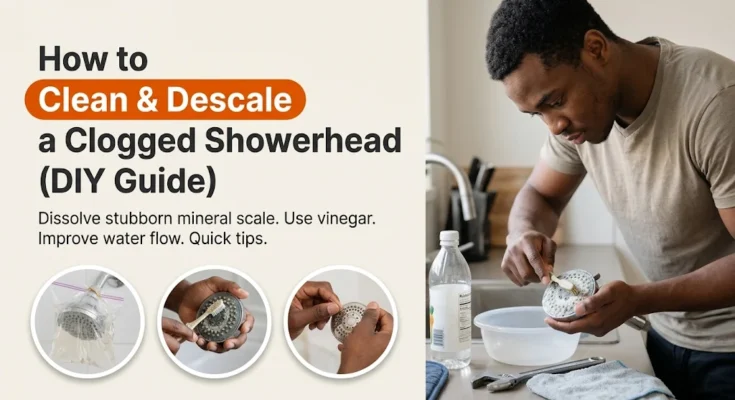
Stepping into the bathroom after a long, sticky afternoon in traffic only to turn on the tap and get hit by three needle-sharp jets shooting sideways against the wall—while the rest of the shower plate barely dribbles—is one of the most irritating household surprises. Across Nigeria, bathroom showers lose their pressure and spray pattern much faster than ordinary basin taps. Most people assume the showerhead is broken and rush to the hardware market to buy a replacement, only to watch the brand-new head block up again a few months later. Figuring out how to clean a clogged showerhead properly restores full, even water pressure in under an hour without spending a single Naira on new plumbing fixtures.
In almost every Nigerian home supplied by a private borehole, deep well, or overhead plastic storage tank, two invisible culprits team up against your shower. First, hard groundwater rich in dissolved calcium, magnesium, and iron dries inside the tiny rubber nozzles after every bath, building up a rock-hard chalky crust known as limescale. Second, fine sand, rust flakes, and sediment washed down from the overhead tank pack tightly against the hidden mesh filter screen inside the shower neck, choking off water flow before it even reaches the faceplate.
Once you understand how to clean a clogged showerhead from both the outside nozzles and the internal inlet screen using ordinary household white vinegar and a soft brush, your shower will spray like the day it was unboxed.
Step 1: Diagnose How to Clean a Clogged Showerhead
Before reaching for tools or soaking solutions, turn the shower on for five seconds and watch how the water behaves. The spray pattern tells you whether the blockage is sitting in the rubber front nozzles or trapped behind the threaded neck.
| What You Notice | Where the Blockage Sits | Main Cause in Nigerian Homes | Best Repair Method |
| Jets spray sideways or split | Front rubber or metal nozzles | Dried white limescale and mineral crusts | Method 1: Vinegar bag soak and nozzle rub |
| Whole shower dribbles weakly | Internal neck filter washer | Overhead tank sand and pipe rust debris | Method 2: Unscrew head and rinse inlet mesh |
| Slimy brown or pink buildup | Around faceplate rim and nubs | Borehole iron bacteria and soap scum | Scrub with baking soda paste after vinegar soak |
| Water leaks from swivel ball | Upper collar thread joint | Crushed rubber washer or mineral grit | Unscrew collar, clean washer, and wrap PTFE tape |
Checking these details first makes how to clean a clogged showerhead much faster:
- Sideways or blocked individual holes: If half the holes spray hard while the others are dead, crusty mineral deposits have plugged the tiny front openings. A simple vinegar soak dissolves these crusts without removing the fixture.
- Sudden drop in pressure after tank washing: If your entire showerhead suddenly slows to a weak trickle right after your overhead tank ran dry or was washed out, loose sand has rushed down the pipe and blinded the tiny wire gauze washer inside the shower connector. Vinegar alone will not melt sand—you must unscrew the head and rinse that screen out.
- Weak pressure across every bathroom tap: If your washbasin tap and toilet cistern are also filling slowly at the same time, the problem is upstream in your plumbing line rather than just the showerhead. Check our troubleshooting guide on How to Fix Low Water Pressure in a Tap to inspect your isolating valves and tank supply.
Important Safety Warnings Before You Descale
Cleaning bathroom fixtures above wet floor tiles involves mild acids, overhead reach, and sometimes electrical water heaters. Keep these precautions in mind before starting:
- Switch off electric water heaters first: If your shower is connected to an instant electric water heater or an overhead storage heater, switch off the double-pole heater switch on the wall (and the circuit breaker) before touching metal shower pipes.
- Never use raw “toilet acid” on showerheads: Street-hawked acidic toilet washes contain harsh hydrochloric (muriatic) acid that strips shiny chrome plating down to dull yellow brass or grey plastic in seconds and melts internal rubber seals.
- Never mix white vinegar with household bleach: Combining acidic vinegar with chlorine bleach (such as Hypo or Jik) releases toxic chlorine gas inside an enclosed bathroom. Use plain white vinegar only.
- Stand on a stable step stool with dry footwear: Wet bathroom tiles are dangerously slick; place a dry cotton towel on the floor and use a sturdy low stool rather than balancing on the rim of a bathtub or plastic bucket.
Tools Needed for How to Clean a Clogged Showerhead
You already have most of the supplies required for how to clean a clogged showerhead sitting in your kitchen cupboard:
- Distilled white household vinegar: About 2 to 3 cups (500 ml to 750 ml) of plain white vinegar from any supermarket or baking supply shop.
- A sturdy polythene nylon bag or zip-top freezer bag: Thick enough to hold half a litre of liquid without leaking (needed for fixed wall or overhead rain showers).
- Strong rubber bands, hair ties, or a strip of cloth twine: To tie the vinegar bag securely around the shower arm.
- Old soft-bristled toothbrush: For scrubbing loosened chalky scale and iron stains off the faceplate.
- Wooden toothpicks or a fine sewing pin: For gently poking softened mineral plugs out of tiny nozzle holes.
- Baking soda (sodium bicarbonate): Two tablespoons to neutralize stubborn greasy biofilm or brownish borehole stains.
- Adjustable spanner (wrench) or pliers and a thick cotton rag: For unscrewing a stuck showerhead collar without scratching the chrome finish.
- Plumber’s PTFE thread seal tape (white tape): Costs around ₦200 to ₦400 at any hardware shop and prevents drips when screwing the head back on.
Method 1: How to Clean a Clogged Showerhead Without Removing It
If your showerhead is mounted high on a fixed wall pipe and only suffers from crusty white nozzles spraying in crooked directions, you do not even need a spanner. Below is how to clean a clogged showerhead right on the wall using the plastic-bag immersion trick.
1. Massage the Rubber Nozzles by Hand
Most modern showerheads have tiny flexible silicone or rubber nibs across the faceplate. Before applying any liquid, turn the water off and rub your thumb firmly back and forth across every row of rubber nibs, pinching them slightly with your fingernails. This flexing motion cracks brittle limescale shells loose inside the tips.
2. Tie a Bag of Undiluted White Vinegar Around the Head
White vinegar contains mild acetic acid that reacts chemically with calcium carbonate scale, dissolving the rock-hard deposits into harmless liquid. For a deeper scientific breakdown of how calcium and magnesium minerals precipitate out of hard household water, see Wikipedia’s reference on Limescale.
- Test the bag for leaks: Pour a splash of water into a heavy-duty polythene bag or freezer bag first to confirm there are no tiny pinholes in the bottom corners.
- Fill the bag halfway with white vinegar: Pour 1.5 to 2 cups of undiluted white vinegar into the bag—do not water it down, as you want full descaling strength.
- Submerge the showerhead face: Lift the bag up over the showerhead so the entire faceplate and all nozzles sit completely underwater inside the vinegar.
- Secure with rubber bands or twine: Gather the top mouth of the bag tightly around the metal shower neck pipe and wrap a thick rubber band or cloth string around it three or four times so the heavy bag cannot slip off and splash onto the floor.
3. Soak, Scrub, and Flush Clean
- Let the showerhead soak for 1 to 2 hours: For standard chrome-plated plastic or stainless-steel heads, let the vinegar work for 60 to 120 minutes. (Important note: If your showerhead has a decorative gold, brass, matte black, or oil-rubbed bronze coating, limit the vinegar soak to 30 minutes maximum so the acid does not dull the specialty finish.)
- Untie the bag carefully: Hold the bottom of the bag with one hand while untying the rubber band with the other, then pour the cloudy used vinegar down the drain.
- Scrub with a toothbrush and baking soda: Dip an old toothbrush in a little baking soda and scrub across the faceplate in small circles to lift away any remaining softened scale or brown borehole slime.
- Poke stubborn holes with a wooden toothpick: If two or three holes still look white, push the tip of a wooden toothpick gently into each nozzle opening to clear the plug. Avoid jamming thick metal nails into soft silicone nibs, which can tear the rubber and ruin the spray jet.
- Flush on full pressure for 2 minutes: Turn the shower tap on full blast and step back for two minutes while the water blasts every dissolved flake out of the internal chamber.
Method 2: How to Clean a Clogged Showerhead by Unscrewing the Neck Filter
What if you soaked the front of the showerhead in vinegar for two hours, the nozzles look spotless, yet the water still comes out as a pathetic trickle? Nine times out of ten in a Nigerian bathroom, the blockage is sitting on the backside of the showerhead inside the threaded connection nut.
Here is how to clean a clogged showerhead completely by removing it and clearing the hidden sediment screen:
1. Unscrew the Showerhead from the Pipe Arm
- For handheld flexible hose showers: Simply hold the ribbed cone nut at the base of the handheld wand and twist the showerhead counter-clockwise (to the left) by hand—most unscrew easily without tools.
- For fixed wall or overhead rain showers: Wrap a folded thick cloth or old towel around the hexagonal swivel nut where the showerhead meets the wall pipe (the cloth stops the metal teeth of your tool from chewing ugly gouges into the chrome). Grip the cloth-wrapped nut with an adjustable spanner or pliers and turn counter-clockwise while holding the wall pipe steady with your other hand so you don’t twist the pipe inside the plastered wall.
2. Pry Out and Rinse the Hidden Mesh Filter Washer
Look directly down into the threaded opening at the back of the removed showerhead. You will see a small black rubber ring with a tiny dome of stainless-steel wire mesh in the middle.
- Lift the filter washer out: Slip the tip of a blunt butter knife, flathead screwdriver, or fingernail under the edge of the rubber washer and pop it gently out of the neck.
- Rinse the sand and rust backward: Hold the mesh screen upside down under a running basin tap so water pushes the trapped sand grains, borehole grit, and black pipe flakes out the same way they came in. Brush the wire gauze gently with your old toothbrush until you can see light clearly through every square of the mesh.
- Inspect the water flow restrictor: Directly beneath that mesh washer, many imported showerheads have a tiny plastic disc with minuscule pinholes (a flow restrictor designed for high-pressure municipal systems). If your home runs on a low-pressure gravity overhead tank, cleaning grit out of that restrictor disc makes an immediate difference to your shower’s power.
3. Soak the Detached Head and Reinstall Leak-Free
Completing this deep-clean sequence is the gold standard for how to clean a clogged showerhead when overhead tank dirt is heavy:
- Submerge the detached showerhead in a bowl of vinegar: Lay the unscrewed showerhead face-down in a plastic bowl filled with white vinegar for 1 hour so the liquid enters both the front nozzles and the rear neck chamber.
- Flush backward under a tap: After soaking and brushing the face, hold the showerhead upside down under a running tap so water enters through the front nozzles and washes loosened grit out the wide back opening.
- Flush the bare wall pipe briefly: Before putting the showerhead back on, place an empty bucket under the bare shower pipe on the wall and turn the tap on for 10 seconds to flush out any loose sand sitting in the pipe elbow.
- Reinstall the mesh washer and wrap fresh PTFE tape: Press the clean rubber mesh washer flat back into the showerhead neck. Wrap 3 to 4 clockwise turns of white plumber’s PTFE thread tape around the male threads of the shower arm pipe, then screw the showerhead back on hand-tight plus a gentle quarter-turn with your cloth-wrapped spanner. (If you notice water dripping from the wall tap handle itself while testing, follow our guide on How to Fix a Leaking Tap to swap out the tap washer.)
How to Keep Borehole Water from Blocking Your Shower
Once you finish how to clean a clogged showerhead, two simple habits will prevent mineral scale and tank grit from choking the nozzles again:
- Give the rubber nubs a 5-second thumb rub once a week: While waiting for your shower water to warm up once a week, rub your fingers briskly across the rubber nozzles. Knocking away microscopic mineral crystals while they are still soft stops them from hardening into solid limestone crusts.
- Keep the mesh neck washer in place: Never throw away the little wire filter washer inside the showerhead neck! Without that ₦200 screen catching sand grains at the entrance, gritty particles from your overhead tank will lodge permanently inside the narrow front nozzles where they are ten times harder to remove.
- Control bathroom dampness and tile stains: Hard borehole water and poor spray angles often splash water high onto painted bathroom walls and floor corners, encouraging mildew and brown rust marks. Keep your bathroom spotless alongside your shower maintenance using our guides on How to Remove Mold from Bathroom Walls Safely and How to Clean and Seal Floor Tiles.
Common Mistakes to Avoid When Cleaning a Showerhead
Avoid these four damaging shortcuts when working through how to clean a clogged showerhead:
- Pouring boiling water over plastic showerheads: Most shiny “chrome” showerheads sold in Nigerian markets are actually made of lightweight ABS plastic electroplated with a thin layer of chrome. Pouring boiling kettle water over them warps the internal plastic channels and causes the faceplate seam to split open under pressure.
- Poking rubber nozzles with thick steel nails or safety pins: Jamming a sharp metal pin into soft silicone spray nibs stretches or tears the tiny rubber aperture, turning a fine mist jet into a sloppy, permanent dribble. Use a wooden toothpick instead.
- Using bare pliers on chrome nuts: Gripping a chrome swivel collar directly with metal pliers leaves jagged teeth marks that rust and peel; always cushion the nut with a folded cloth first.
- Leaving vinegar on brass or matte-black finishes overnight: While stainless steel handles a two-hour soak easily, soaking coated designer finishes overnight can cause the colour to blister or fade.
Frequently Asked Questions (FAQs)
Can I use lemon juice or Coca-Cola if I don’t have white vinegar?
If you run out of white vinegar while figuring out how to clean a clogged showerhead, fresh lemon or lime juice works well because its natural citric acid dissolves calcium scale just like vinegar (just rinse thoroughly afterward so fruit pulp doesn’t stick inside the holes). Avoid using sugary sodas like Coca-Cola—their acid level is far too weak to melt thick borehole limescale, and the sugar leaves a sticky residue inside the head.
How often should I descale my showerhead in a Nigerian home?
In areas with hard borehole water or iron-rich well water, perform a quick 1-hour vinegar bag soak every 2 to 3 months, and unscrew the neck to rinse out the sand filter washer every 6 months (or immediately after washing your overhead storage tank).
Why is water leaking from the top neck of my showerhead after I screwed it back on?
A drip at the threaded collar after reassembly means either the small black rubber washer inside the nut fell out while you were cleaning it, the washer is sitting crooked, or the metal threads need 3 to 4 wraps of white plumber’s PTFE tape to seal the gap. Unscrew the nut, seat the flat rubber washer squarely inside, wrap fresh PTFE tape clockwise around the pipe threads, and tighten snugly by hand.
Final Thoughts
Taking forty-five minutes to dissolve crusty mineral buildup in white vinegar and rinse trapped tank sand out of the neck filter proves just how easy it is to master how to clean a clogged showerhead. Instead of putting up with weak, sideways sprays or wasting money on replacement fixtures, your bathroom shower will deliver a strong, refreshing downpour every single day.