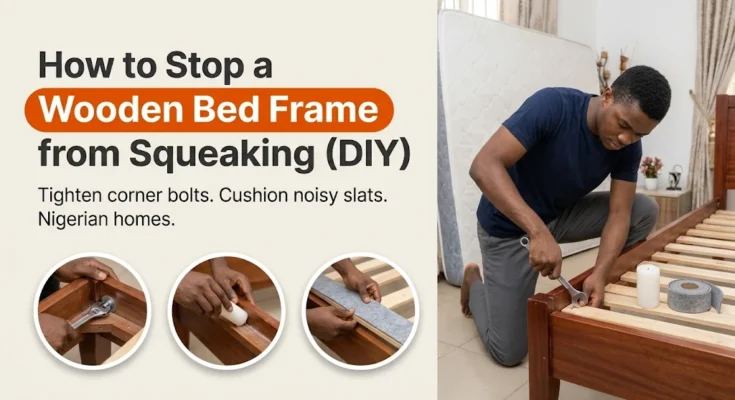
Rolling over at 3:00 AM only to hear a loud, sharp creak-groan echo across a quiet bedroom—waking up your partner or baby every time you shift your weight—is one of the most exhausting household nuisances. Across Nigerian homes, locally crafted hardwood, gmelina, and MDF upholstered bed frames take a heavy beating from seasonal weather swings. Timber that swells snugly during the damp rainy months shrinks and dries out as soon as Harmattan winds arrive or the bedroom air conditioner runs all night, opening up tiny 1-millimetre gaps at the corners and under the mattress boards. Figuring out how to stop a wooden bed frame from squeaking yourself takes less than forty-five minutes and costs almost nothing, saving you from calling a roadside carpenter or buying a new bed.
Many people blame their foam mattress first, not realizing that high-density Nigerian foam mattresses have no metal springs inside to make noise. Almost every groan, pop, or chirp coming from your bed is caused by dry wood rubbing against dry wood along the inner slat ledges, or metal corner brackets shifting loosely inside oversized screw holes.
Once you understand how to stop a wooden bed frame from squeaking by isolating the noise zone, waxing the friction points, locking down the corner hardware, and cushioning the wooden slats, your bed will feel rock-solid and stay completely silent all night long.
Step 1: Diagnose How to Stop a Wooden Bed Frame from Squeaking
Before pulling tools out of your box, lift the mattress off the frame and set it upright against the bedroom wall. Press down firmly with both hands on different parts of the bare wooden frame—first the four corners, then the long side rails, and finally the individual wooden slats—to hear where the noise lives.
| Noise Location | What It Sounds Like | Root Cause in Nigerian Beds | Required Fix |
| Headboard or footboard corners | Deep wooden groan or loud pop | Loose 13 mm bolts or hook-in brackets | Method 1: Tighten bolts, add washers, and wax seams |
| Across the middle under mattress | Rapid creaking when rolling over | Dry wooden slats rubbing the side ledge | Method 2: Wax slat ends or wrap in cloth/felt pads |
| Directly under the centre of bed | Heavy thump or sharp snap | Floating centre support leg or loose block | Method 3: Shim centre post and screw slats down |
| Bottom of bed legs on floor | High-pitched chirp or skid | Uneven bed legs sliding on ceramic tiles | Method 4: Stick felt pads or rubber grips under legs |
Checking these four zones first makes how to stop a wooden bed frame from squeaking straightforward:
- Corner joint movement: If the headboard rocks backward and forward by more than a centimetre when you push it, the metal corner fasteners have worked loose. Every time you sit on the edge of the bed, the side rail slides down and grinds against the corner post.
- Rough-sawn mattress slats (“bed boards”): Most local carpenters cut internal bed slats from unplaned softwood or abura planks. When those rough plank ends sit directly on the inner wooden ledge without padding, every movement of the mattress rubs the dry wood fibres together like sandpaper.
- Floor tile vs. frame noise: Occasionally, a creak that sounds like the bed is actually a loose floor board underneath the bed leg—if your bedroom has timber flooring, check our guide on How to Fix a Squeaky Wooden Floorboard to rule out the subfloor first.
Important Safety Warnings Before You Work
Heavy wooden bed frames, thick 8-inch to 12-inch mattresses, and metal brackets can pinch fingers or strain your lower back if handled carelessly. Keep these precautions in mind before starting:
- Get a second person to help lift heavy mattresses and headboards: King-size (6 ft × 6 ft) mattresses and solid mahogany headboards are awkward to balance alone; lift with your knees rather than bending your waist.
- Watch out for rusty nails and wood splinters on bed slats: Unfinished wooden bed boards often have rough splinters or protruding carpenter nails along the edges; wear work gloves before running your hands along the inner rails.
- Support the side rail before unbolting a corner: Never loosen all four corners of a bed frame at the same time, or the heavy headboard can tip forward onto your feet. Work on one corner joint at a time.
- Protect your floor tiles from heavy wood corners: Lay an old bedsheet or flattened cardboard box under the frame corners while adjusting hardware so metal brackets or dropped spanners do not chip your ceramic floor tiles.
Tools Needed for How to Stop a Wooden Bed Frame from Squeaking
You can gather almost everything required for how to stop a wooden bed frame from squeaking right from your house or a nearby hardware shop:
- 13 mm or 14 mm spanner (wrench) or socket driver: For tightening standard hex bed bolts inside corner posts.
- Phillips (star) and flathead screwdrivers: For driving wood screws into loose corner blocks and side ledges.
- Plain white paraffin wax candle or dry bar soap: Rubbing dry wax onto wood-on-wood joints is the cleanest way to eliminate friction squeaks without staining your bedsheets.
- Metal flat washers or split lock washers (₦50 to ₦100 each): Stops loose bed bolts from sinking into soft wood and backing out again.
- Cushioning strips (old cotton socks, strips of towel, or self-adhesive felt pads): Forms a silent buffer between the wooden slats and the side rails.
- PVA wood glue (such as Topbond) and wooden toothpicks or matchsticks: For packing and tightening stripped screw holes in wooden rails.
- 35 mm (1.5-inch) wood screws: For locking sliding bed slats securely onto the inner support cleats.
Method 1: How to Stop a Wooden Bed Frame from Squeaking at the Corner Joints
Nine times out of ten, the loudest groan in a wooden bed comes from the four corner joints where the two long side rails hook or bolt into the headboard and footboard. Here is how to stop a wooden bed frame from squeaking at the corners permanently:
1. Tighten Corner Bolts and Add Metal Washers
If your bed uses long steel bolts that pass through the corner post into a cross-dowel (barrel nut) inside the side rail:
- Unscrew the bolt slightly to inspect the hole: If the bolt head has dug a sunken crater into the wood, the bolt will never stay tight on its own.
- Slide a wide steel flat washer and a split lock washer onto the bolt: The flat washer spreads the clamping pressure across a wider area of wood, while the springy lock washer stops night-time vibration from loosening the nut.
- Tighten all four corners in an X-pattern: Snug each corner bolt to about 80% tightness first, make sure the bed frame sits square on the floor, and then wrench all four bolts tight in a diagonal criss-cross sequence.
2. Shim Loose “Hook-In” Metal Bed Brackets
Many Nigerian carpenter-built beds use flat steel hook plates set into a slot in the headboard post that hook over two metal pins inside the side rail. When those slots wear loose, the rail clanks and groans every time you sit down.
- Lift the side rail hook upward out of the headboard slot: Have a helper steady the headboard while you tap the bottom of the side rail upward with the heel of your hand or a rubber mallet to unhook it.
- Tighten the small screws holding the metal plate: Often, the four wood screws holding the metal hook plate inside the rail have stripped out of the wood. If a screw spins loosely, pack the hole with two wooden toothpicks dipped in PVA wood glue and drive the screw back in tight—the exact same repair method covered in our guide on How to Fix a Wobbly Chair Leg.
- Rub candle wax on the wooden meeting faces: Before hooking the side rail back into the headboard, rub an ordinary white paraffin wax candle generously over the vertical end of the wooden side rail and inside the headboard slot.
- Slide a folded cardboard or plastic shim into the hook slot: If the metal hook still rocks loosely after pushing it down, cut a narrow strip from a plastic bottle or thick cereal box and wedge it tightly between the wooden rail end and the headboard post so the joint cannot shift.
Method 2: How to Stop a Wooden Bed Frame from Squeaking Along the Slats
If the four corners of your bed are tight, yet you still hear a chorus of dry creaks across the middle of the bed whenever you turn over, the culprit is your wooden mattress slats (or flat plywood base sheets) rubbing against the inner support ledge (cleat) of the side rails. For a clearer look at how side rails, center beams, and support slats distribute load across different bed designs, see Wikipedia’s reference on Bed frame.
Follow these three steps when learning how to stop a wooden bed frame from squeaking under the mattress:
1. Lift Out the Wooden Slats and Check for Warped Planks
Lift each wooden slat (or the two halves of your flat plywood mattress board) off the frame. Inspect every plank for cracks, loose knots, or banana-shaped warping caused by humidity changes—a common issue we explain in How to Care for Wooden Floors in a Humid Climate. Flip any slightly bowed slat so the curve arches upward toward the mattress rather than sagging downward.
2. Wax the Inner Support Ledges with a White Candle
Take an ordinary white household candle (or a dry cake of bath soap) and rub it vigorously along the entire top face of the wooden support ledges running down both side rails and the central support beam. Also rub the candle across the bottom 10 centimetres of both ends of every wooden slat. This invisible layer of dry paraffin wax acts as a friction-free barrier so the wood glides silently instead of sticking and snapping.
3. Cushion the Slat Ends with Cloth, Socks, or Felt
For rough-cut Nigerian timber slats that chatter against the frame whenever you sit down, add a soft fabric cushion between the boards:
- The Old Cotton Sock Trick (Free & Instant): Slip an old, clean cotton sock (or wrap a folded strip of old towel) over the left and right ends of each wooden slat before laying it back into the bed frame. With soft fabric sitting between the slat and the side rail, wood-on-wood squeaking becomes physically impossible!
- Self-Adhesive Felt Strip or Cork Tape: Alternatively, stick a continuous strip of self-adhesive furniture felt or thin foam weatherstripping tape along the top of the side-rail ledges before setting the slats back down.
- Screw the end slats down: To keep your slats from sliding together into a pile over time, drive one 35 mm wood screw through both ends of the very first slat (at the head), the middle slat, and the last slat (at the foot) into the support ledge, leaving a 2-millimetre gap between the slat end and the outer side wall so it doesn’t rub.
Method 3: Secure the Centre Support Beam and Bed Legs
Queen-size (4.5 ft × 6 ft) and King-size (6 ft × 6 ft) beds have a long wooden or metal beam running down the middle of the bed from head to foot, supported by one to three short vertical legs underneath. If one of those middle legs is floating 3 millimetres off the floor tiles—or leaning crookedly—it makes a loud clack-squeak every time weight presses the mattress down.
- Check that every middle support leg touches the floor firmly: Crawl or look underneath the bed while someone sits on the mattress. If a middle leg hangs in the air until someone sits down, slide a tight wooden wedge, folded rubber mat, or furniture coaster underneath it so it bears weight evenly at all times.
- Straighten tilted middle legs: If a middle support post has been kicked sideways while sweeping under the bed, push it back to a straight 90-degree vertical angle and drive an L-shaped metal corner bracket (₦300 at any hardware store) into the joint between the post and the center beam.
- Stick felt or rubber pads under all outer bed legs: Bare wooden or metal bed legs resting directly on glossy Nigerian ceramic floor tiles can let out a high-pitched squeak whenever the bed shifts by half a millimetre. Stick heavy-duty felt pads or cut squares of old car inner-tube rubber under all four corner legs.
- Silence folding metal storage mechanisms: If your wooden bed has a lift-up hydraulic storage base that creaks at the metal pivot hinges, wipe away the black dust and apply a dab of white lithium grease or petroleum jelly to the pivot pins using the exact technique in our guide on How to Stop Squeaky Door Hinges Permanently.
Common Mistakes to Avoid When Fixing a Squeaky Bed
Avoid these four counterproductive shortcuts when tackling how to stop a wooden bed frame from squeaking:
- Spraying WD-40 or pouring cooking oil onto raw wooden slats: Wood is porous; liquid oils soak into the timber grain, soften the wood fibres, leave rancid grease stains on the underside of your expensive mattress, and attract cockroaches or ants. Always use dry candle wax, dry bar soap, or cloth padding on wooden parts.
- Nailing every slat down with smooth carpenter nails: Hammering smooth iron nails through bed slats into the side rails guarantees worse squeaks within three months! As the wood shrinks and flexes, the smooth nail shaft rubs up and down inside the wood hole with a loud metallic screech. Use threaded wood screws or cloth wrapping instead.
- Over-tightening bolts into cracked particleboard (MDF): If your imported bed is made of compressed MDF rather than solid timber, cranking a spanner with all your strength can split the corner board open. Add a wide flat washer and tighten until snug and firm.
- Forgetting to check if the headboard is rubbing the plaster wall: Sometimes a rhythmic squeak isn’t inside the bed joint at all—it is the back of the wooden headboard rubbing against your painted bedroom wall! Pull the bed frame 2 centimetres away from the wall or stick two soft foam bumpers on the back of the headboard.
Frequently Asked Questions (FAQs)
How do I tell if it is my mattress or my wooden bed frame that is squeaking?
The easiest test when figuring out how to stop a wooden bed frame from squeaking is to lift your mattress off the bed, lay it flat on the clean bedroom floor, and roll around on it. If the mattress is completely silent on the floor (which is true for 99% of high-density Nigerian foam mattresses like Mouka, Vitafoam, or Winco), then 100% of the noise is coming from your wooden bed frame slats and corner joints.
Why did my wooden bed suddenly start squeaking during Harmattan?
Wood is a natural material that expands when the air is humid and shrinks when the air turns dry. During dry Harmattan months (or in bedrooms where an air conditioner removes indoor moisture every night), wooden rails and slats lose moisture and shrink slightly, loosening bolts that were tight in the rainy season and allowing dry timber surfaces to rub together.
Can I put a rug or carton under my mattress to stop the slats from squeaking?
Laying a clean woven mat, thick moving blanket, or flattened heavy cardboard sheet directly over the wooden slats before putting the mattress back down helps spread your body weight evenly across five or six slats at once instead of flexing a single board. However, for a permanent cure, always wax or cushion the ends of the wooden slats where they rest on the side rails first.
Final Thoughts
Taking forty-five minutes to tighten your corner bolts over wide washers, rub white candle wax along the inner support ledges, and wrap or pad the ends of your mattress slats proves just how simple it is to master how to stop a wooden bed frame from squeaking. With every joint locked tight and every wood-on-wood contact point cushioned, you can finally enjoy deep, uninterrupted sleep without a single creak in the night.