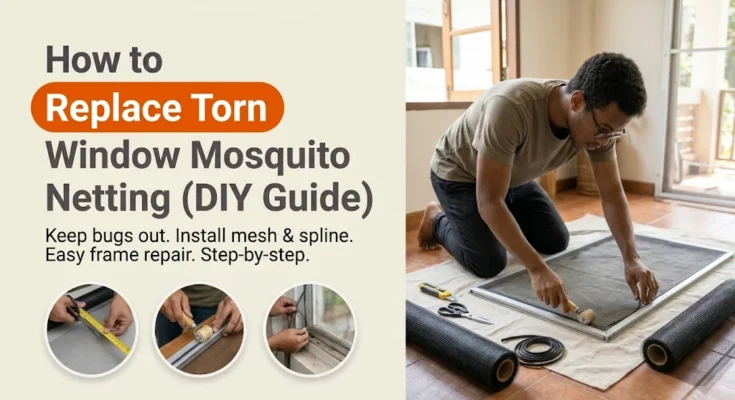
Nothing ruins a peaceful night’s sleep faster than that high-pitched buzz right beside your ear at 2:00 AM—especially when grid power drops on a humid night and you slide the bedroom window open for fresh air. You wake up the next morning covered in itchy bites, inspect the window, and spot the culprit immediately: a rusted hole in the middle of the wire gauze, or a sagging corner where the black rubber cord has dried out and popped loose from the aluminium frame.
Figuring out how to replace window mosquito netting yourself is the fastest, cheapest way to lock mosquitoes out of your house without paying an aluminium fabricator or carpenter four times the cost of the materials.
Across Nigerian homes, window screens take a relentless beating from baking afternoon sun, heavy rainy-season winds, curious pets, and indoor cleaning brushes. After two or three years, cheap nylon nets turn brittle and crumble like dry paper whenever you touch them, while low-grade iron wire rusts through and stains your window sill brown. Yet the metal or wooden frame holding that net is almost always in perfect condition.
Once you understand how to replace window mosquito netting using a roll of durable fibreglass or aluminium mesh, a few metres of fresh rubber spline, and a simple hand roller, you can re-mesh any sliding aluminium screen or wooden window frame in under thirty minutes.
Step 1: Choose the Right Mesh Before You Replace Window Mosquito Netting
Walk into any building materials market or hardware shop in Nigeria and ask for “window net,” and the seller will usually show you three or four different rolls. Picking the right mesh material determines whether your repair lasts five years or five months.
| Mesh Material | Typical Cost (Per Yard) | Durability in Nigerian Weather | Best Use Case |
| Coated Fibreglass Mesh | ₦1,800 – ₦3,500 | High (will not rust, crease, or rot in rain) | Sliding aluminium window frames and bedrooms |
| Aluminium / Stainless Wire | ₦2,500 – ₦4,500 | Very High (resists rats, pets, and sparks) | Ground-floor windows, kitchens, and wooden frames |
| Nylon / Plastic Mesh | ₦800 – ₦1,500 | Low (turns brittle in sun and tears easily) | Temporary budget fixes in shaded corridors |
| Galvanized Iron Wire | ₦1,500 – ₦2,500 | Medium (strong, but rusts in coastal humidity) | Dry inland areas and store room vents |
Keep these practical differences in mind when planning how to replace window mosquito netting:
- PVC-coated fibreglass mesh (Recommended for aluminium frames): Soft, flexible, and finished in charcoal grey or black so it reduces glare while allowing maximum breeze through the room. Unlike metal wire, fibreglass stretches smoothly into the narrow groove of an aluminium frame without cutting the rubber cord.
- Aluminium or stainless-steel wire gauze (Best against rodents): If your ground-floor kitchen or store window is frequently chewed by rats or scratched by dogs, soft fibreglass will not stop them. Use woven aluminium or stainless-steel mesh instead.
- Avoid cheap coloured nylon netting on sunny walls: Green, blue, or white plastic netting bakes quickly under tropical UV sunlight, shrinking until it pulls the frame inward or splits open at the seams.
Important Safety Warnings Before You Begin
Working with removed window frames, utility blades, and old rusted wire gauze carries a few sharp hazards. Follow these precautions before starting:
- Wear protective work gloves when pulling out old wire mesh: Rusted iron or aluminium wire netting leaves needle-sharp metal strands around the frame edges that puncture bare fingers easily and carry tetanus risks.
- Protect your eyes when prying tacks or cutting wire: Snapping corroded nails out of wooden window frames or trimming stiff wire mesh can flick sharp metal bits toward your face—wear safety glasses just as we emphasize in our guide on 3 Ingenious Ways to Cut Glass Without a Glass Cutter.
- Never lean your body weight against an open upstairs window: Always lift removable sliding screen frames inside the room to work on a flat table or floor rather than leaning out over a balcony ledge.
- Keep the utility knife angled away from your supporting hand: When trimming excess mesh along the rubber groove, always pull the blade away from your fingers.
Tools and Materials Needed to Replace Window Mosquito Netting
You can buy everything needed for how to replace window mosquito netting at a neighbourhood hardware store, timber market, or aluminium accessories shop:
- Replacement mosquito mesh: Measure the height and width of your window frame and add 10 cm (4 inches) of extra margin on all four sides so you have plenty of grip while stretching.
- Screen rolling tool (Spline roller): A cheap handheld tool (around ₦1,500 to ₦2,500) with two small wheels—one rounded (convex) wheel for pushing the mesh into the groove, and one grooved (concave) wheel for pressing the rubber cord in. (DIY fallback: If you only have one window to fix, the smooth, rounded edge of an old spoon handle or a blunt flathead screwdriver can work in a pinch, though you must be careful not to tear the mesh.)
- New rubber spline (“Net rubber” — for aluminium frames): The flexible black rubber cord that locks the mesh into the frame channel, typically 4 mm to 5 mm thick. If your old rubber spline is still soft and stretchy, you can wash and reuse it; if it feels hard, cracked, or brittle, buy a fresh roll for ₦500 to ₦1,500.
- Sharp utility knife (box cutter) and heavy-duty scissors: For trimming excess netting cleanly.
- Flathead screwdriver or awl: For prying up the end of the old rubber spline.
- For wooden window frames only: A small claw hammer, pincers/pliers, a handful of 15 mm (½-inch) tack nails or staple gun, and thin wooden beading strips (battens) if the old strips are rotten.
Method 1: How to Replace Window Mosquito Netting on Aluminium Sliding Windows
Most modern Nigerian flats and bungalows use removable aluminium net frames that slide on a dedicated track alongside the glass panels. Here is how to replace window mosquito netting on an aluminium frame without bending the light metal rails:
Step 1: Lift the Screen Frame Out and Strip the Old Mesh
- Remove the frame from the window track: Grip both vertical sides of the aluminium screen frame, lift it upward into the top channel until the bottom edge swings clear of the lower track, and bring it inside onto a clean dining table or flat floor mat. (If the frame jams in the track, check our troubleshooting steps in How to Fix a Sticking Door for clearing bent guides and grime.)
- Pry up the old rubber spline: Locate one corner of the black rubber channel running around the inner perimeter of the frame. Dig the tip of a small flathead screwdriver under the end of the rubber cord and pull it all the way out of all four sides.
- Scrub the aluminium frame clean: Pull off the torn mesh and discard it safely. Use an old toothbrush and soapy water to scrub Harmattan dust, dead insects, and cobwebs out of the narrow spline groove, then wipe the frame completely dry.
Step 2: Lay Out and Align the New Mesh
- Unroll the new fibreglass mesh over the frame: Lay the frame flat with the spline groove facing upward. Roll your new mesh across the top so it overhangs the outer edges of the frame by at least 4 cm to 5 cm on every side.
- Align the weave square with the frame: Look closely at the tiny grid lines of the mesh and line them up parallel to the aluminium bars. If the grid is crooked, the screen will pucker diagonally when you roll the rubber in.
- Pre-crease the mesh lightly (For stiff aluminium mesh only): If you are using metal wire mesh instead of soft fibreglass, use the rounded wheel of your spline roller to gently roll the mesh 2 mm down into the groove along all four sides before inserting the rubber.
Step 3: Roll the Rubber Spline into the Groove (Without Bowing the Frame!)
The most common mistake people make when learning how to replace window mosquito netting is pulling the mesh way too tight across the middle of the frame. Because aluminium screen bars are hollow and thin, over-stretching the mesh pulls the long vertical sides inward like an hourglass, leaving gaps on both sides of your window where mosquitoes fly right past the frame!
- Start at the top-left corner and roll across the short top edge: Press the tip of your black rubber spline into the top-left corner using a screwdriver. Switch to the grooved (concave) wheel of your spline roller and roll the rubber firmly into the channel along the entire top width of the frame.
- Roll down the first long vertical side: Turn the corner and roll the spline down one long side, keeping the mesh flat and aligned without yanking it sideways.
- Hold slight tension and roll the bottom edge: Gently pull the mesh taut at the bottom with one hand while rolling the spline across the bottom rail with your other hand.
- Prevent the “Hourglass Bow” on the final long side: As you roll the rubber down the final vertical side, place your free hand in the centre of the mesh or have a helper hold the middle of the aluminium bars outward so the frame stays perfectly rectangular. The screen should feel firm like a light drum—not stretched to the breaking point.
- Tuck the corners in with a blunt screwdriver: Wherever the rubber turns a 90-degree corner, push it snugly down into the corner slot with the flat face of your screwdriver and slice off the excess tail of the rubber cord. For a deeper technical overview of how spline channels and tensioned mesh assemblies work across different building styles, see Wikipedia’s guide on Window screen.
Step 4: Trim the Excess Mesh Cleanly
- Hold your utility knife at a 45-degree angle: Place the tip of a sharp utility blade right against the outer lip of the rubber spline (tilted away from the main window screen screen face so a slip cannot slice your brand-new mesh!).
- Run the blade smoothly around all four sides: Slice off the overhanging flap of netting flush with the outer edge of the spline groove.
- Reinstall and test the window: Pop the finished frame back into your upper window track first, drop the bottom onto the lower runner, and slide it closed. Check all four edges to confirm the frame sits flush against the glass interlock bar.
Method 2: How to Replace Window Mosquito Netting on Wooden Frames
Many older Nigerian homes,boys’ quarters (BQ), and louvre-window houses use fixed wooden mosquito netting nailed to the outside or inside of the wooden window jamb and capped with narrow wooden strips (called battens or beading). Here is how to replace window mosquito netting on a wooden window frame:
- Pry off the thin wooden beading strips carefully: Slide a wide putty knife or flat pry bar behind the narrow wooden strips nailed around the edge of the window frame. Lever them off gently from end to end so you don’t split the wood—you will reuse these strips at the end.
- Pull out all old tack nails and staples: Use pliers or pincers to yank out every rusted nail left sticking out of the frame and the removed wooden strips. Sweep and sand the wooden ledge smooth.
- Cut your mesh to fit the inner wooden rebate: Measure the opening and cut your coated fibreglass or aluminium wire mesh so it overlaps onto the wooden nailing ledge by 2 cm on all sides.
- Tack the top edge first: Hold the mesh square against the top of the frame and drive 15 mm tack nails (or heavy-duty staples) every 8 cm to 10 cm across the top bar.
- Stretch downward and tack the bottom edge: Pull the bottom of the mesh evenly downward until all wrinkles disappear, then nail across the bottom sill from the centre outward.
- Tack the left and right sides: Pull each vertical side taut without warping the grid and nail it down every 8 cm. Trim off any messy wire ends sticking past the ledge.
- Nail the wooden beading strips back over the edges: Reposition your four wooden cover strips right over the nailed mesh edges to hide the sharp wire ends and lock the net firmly against wind gusts. While you have your screwdriver and hammer out by the window and door frames, it is also a smart time to check nearby latches using our guide on How to Fix a Loose Door Handle.
Common Mistakes to Avoid When Replacing Mosquito Nets
Steer clear of these four pitfalls while working through how to replace window mosquito netting:
- Pulling the mesh so tight that the aluminium frame bends inward: If the middle of your aluminium frame curves inward by even 5 millimetres, mosquitoes will enter through the side gap between the net frame and the glass frame. Keep the long bars straight while rolling the spline.
- Using a sharp knife to push the rubber spline in: Never use a kitchen knife or sharp chisel to press the rubber cord into the groove; one slip will slice a fresh cut right along the edge of your new mesh.
- Forgetting to check the hairy weatherstripping (“felt brush”) around the frame: Sliding aluminium screen frames have a thin grey fuzzy brush strip tucked along the edge that seals the gap against the glass panel. If that fuzzy strip has rotted away, mosquitoes will crawl around the frame even with a brand-new net.
- Leaving rusty wire clippings on your floor tiles: Tiny snipped pieces of aluminium or iron wire puncture bare feet and leave rust spots on damp tiles—sweep up immediately and follow our tips on How to Clean and Seal Floor Tiles if old window rust stained your floor below.
Frequently Asked Questions (FAQs)
Which mosquito net material lasts longest in Nigeria?
For standard bedroom and parlour windows, PVC-coated fibreglass mesh lasts 5 to 8 years because it never rusts in heavy rain and does not turn brittle under hot sunshine. For ground-floor kitchens or store windows where rats try to chew through the screen, woven aluminium or stainless-steel wire mesh is the toughest choice.
How do I know what size rubber spline to buy for my aluminium window?
Most Nigerian aluminium sliding net profiles use either a 4 mm (0.160-inch) or 5 mm (0.175-inch) ribbed rubber spline. Snip a 2-centimetre piece of your old rubber cord and take it with you to the aluminium accessories shop so the seller can match the exact thickness.
Can I patch a small hole in my window net instead of replacing the whole sheet?
Yes! If your screen is still strong and only has one tiny tear (under 3 cm wide), you do not need to tackle how to replace window mosquito netting across the entire frame yet. You can stick a self-adhesive fibreglass mosquito net repair patch (sold in packs for ₦1,000 to ₦2,000) directly over the clean, dry hole, or weave a small square of spare wire mesh over the tear using thin thread or clear silicone adhesive.
Final Thoughts
Taking thirty minutes on a Saturday morning to strip away brittle, rusted gauze and roll in fresh fibreglass mesh proves just how simple it is to master how to replace window mosquito netting. With every window frame sitting flat, tight, and gap-free, you can throw your windows wide open for cool evening breeze without letting a single mosquito inside.